Poverty in America Today – Who Pays, Who Benefits: Tax Policy and Economic Inequality
April 8, 2026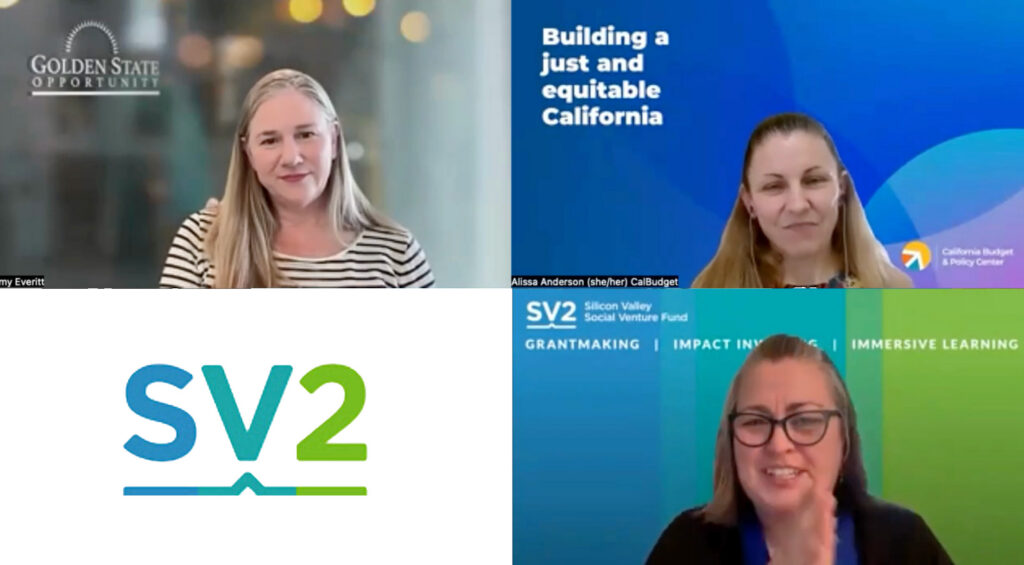
What if one of the most powerful tools to reduce poverty… is already in place?
I recently had the opportunity to moderate Silicon Valley Social Venture Fund’s (SV2) conversation on poverty and economic mobility as part of our Poverty in America Today series. After seven webinars focusing on the impact and causes of living in poverty, the conversation in March focused on tax policy and I came away with a fundamental conclusion: Tax policy is one of the most powerful tools we have to reduce poverty.
In my conversation with Alissa Anderson of the California Budget and Policy Center, we broke this down in simple terms:
- A family earning $33,000 can receive thousands back through refundable tax credits—sometimes resulting in a negative tax rate.
- A family earning $300,000 is stable, but not necessarily building significant wealth.
- A family earning $1 million often pays a similar effective tax rate as the $300K household—while continuing to accumulate wealth.
That’s not accidental. It’s policy design.
As I shared in the conversation: “The tax code stabilizes the bottom, sustains the middle—but accelerates wealth at the top.”
Our tax system is more than numbers—it reflects our values. One of my favorite lessons from Gloria Steinem is that you can understand your values by looking at your checkbook. Today, that might be your bank statement—or at a larger scale, our public budget.
When you look at federal spending, it tells a clear story about what we prioritize. About $1.1 trillion goes to public support programs that help tens of millions of people barely get by, compared to spending about $900 billion just for defense.
When we look at where public dollars go, we see our priorities clearly. And we know this:
✔️ Programs like the Earned Income Tax Credit (EITC) work
✔️ They improve child health and education outcomes
✔️ They increase long-term earnings
These are some of the most effective anti-poverty tools we have.
But the system isn’t working as well as it could.
Even in California—home to one of the most progressive income tax systems in the country—many low-income families still pay a disproportionate share when you factor in sales taxes, property taxes, and the complexity of accessing benefits. And major tax breaks and loopholes continue to benefit those with the most wealth.
“California’s tax system is considered progressive, but only to a point,” Alissa said. “While the top 1% pays the largest share, low-income households pay the second largest. That’s because regressive taxes like sales and property taxes outweigh the benefits of a progressive income tax, leaving some of the lowest-income families paying a higher share than wealthier ones.”
Poverty isn’t inevitable. It’s the result of policy choices.
And that means we can choose differently. Tax policy determines who has resources, who has stability and who has a real chance to get ahead.
At GSO, we see this every day—helping working families access tax credits, keep more of what they earn, and build financial stability.